If you've ever stared at a piping and instrumentation diagram trying to figure out what "PSV," "FCV," or "LT" means, you already know why learning common P&ID abbreviations matters. These shorthand codes are the language of process engineering. Without them, reading a P&ID is like trying to read a road map written in a foreign alphabet. For process engineers, instrument technicians, and plant operators, memorizing these abbreviations isn't optional it's the baseline skill that separates someone who can work independently from someone who constantly needs help interpreting drawings.
Getting familiar with P&ID abbreviations also speeds up safety reviews, commissioning, and troubleshooting. When a control room operator says "the LIC on T-201 is reading high," you need to know immediately that a level indicating controller on a specific tower is involved. The faster you decode these terms, the faster you respond to real plant situations.
What Do P&ID Abbreviations Actually Represent?
P&ID abbreviations are standardized letter combinations used to identify instruments, valves, equipment, and control functions on piping and instrumentation diagrams. They follow conventions laid out primarily by the ISA 5.1 notation standards, which define how each letter position in an instrument tag conveys a specific meaning.
A typical instrument tag uses a combination of letters to describe:
- First letter the measured variable (temperature, pressure, flow, level, etc.)
- Second letter the modifier (difference, scan, high, low)
- Subsequent letters the output or passive function (indicating, recording, controlling, transmitting, alarming)
For example, PDT breaks down as P (pressure) + D (differential) + T (transmitter). It's a pressure differential transmitter. Once you understand this pattern, you can decode almost any instrument abbreviation without memorizing hundreds of individual codes.
How Does the ISA Letter Code System Work?
The ISA (International Society of Automation) system assigns each letter a specific role. Here's how the positions work together:
First letter Measured or Initiating Variable:
- A Analysis (composition, pH, etc.)
- B Burner, Combustion
- C User's choice (often Conductivity)
- D User's choice (often Density)
- E Voltage
- F Flow
- G Gaging (position, dimensions)
- H Hand (manual)
- I Current (Electrical)
- J Power
- K Time, Schedule
- L Level
- M User's choice (often Moisture)
- N User's choice
- O User's choice
- P Pressure
- Q Quantity, Totalizer
- R Radiation
- S Speed, Frequency
- T Temperature
- U Multivariable
- V Vibration
- W Weight, Force
- X Unclassified
- Y Event, State, Presence
- Z Position, Dimension
Succeeding letters Output/Passive Functions:
- A Alarm
- C Controller
- D Differential
- E Element (primary sensing element)
- G Glass, Gauge (local visualization)
- H High
- I Indicating
- K Control station
- L Light, Low
- R Recording
- S Switch
- T Transmitting
- V Valve, Damper, Louver
- Y Converter, Relay, Compute
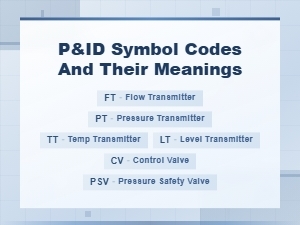
When you combine these, TRC means Temperature (T) + Recording (R) + Controller (C) a temperature recording controller. Understanding the P&ID symbol codes and their meanings alongside these abbreviations gives you full reading ability.
What Are the Most Common P&ID Abbreviations Process Engineers See Daily?
In real plant environments, certain abbreviations come up far more often than others. Here are the ones you'll encounter on nearly every project:
Temperature Instruments
- TI Temperature Indicator
- TIC Temperature Indicating Controller
- TIR Temperature Indicating Recorder
- TT Temperature Transmitter
- TE Temperature Element (thermocouple, RTD)
- TRC Temperature Recording Controller
- TAH Temperature Alarm High
- TAL Temperature Alarm Low
- TAHH Temperature Alarm High-High
Pressure Instruments
- PI Pressure Indicator
- PIC Pressure Indicating Controller
- PT Pressure Transmitter
- PDT Pressure Differential Transmitter
- PDI Pressure Differential Indicator
- PSH Pressure Switch High
- PSL Pressure Switch Low
- PAH Pressure Alarm High
- PSV Pressure Safety Valve
Flow Instruments
- FI Flow Indicator
- FIC Flow Indicating Controller
- FT Flow Transmitter
- FE Flow Element (orifice plate, venturi, etc.)
- FRC Flow Recording Controller
- FCV Flow Control Valve
- FDV Flow Diverting Valve
Level Instruments
- LI Level Indicator
- LIC Level Indicating Controller
- LT Level Transmitter
- LG Level Gauge (sight glass)
- LSH Level Switch High
- LSL Level Switch Low
- LSHH Level Switch High-High
- LAH Level Alarm High
Valves and Final Control Elements
- CV Control Valve
- FCV Flow Control Valve
- MOV Motor-Operated Valve
- SOV Solenoid-Operated Valve
- SDV Shutdown Valve
- BDV Blowdown Valve
- ESDV Emergency Shutdown Valve
- HV Hand-Operated Valve
- PRV Pressure Relief Valve
- PSV Pressure Safety Valve
- RV Rupture Disc/Vent
Analyzers
- AT Analyzer Transmitter
- AE Analyzer Element
- AIC Analyzer Indicating Controller
- pH pH Analyzer
- CE Conductivity Element
Common Equipment Abbreviations
- T Tank
- V Vessel
- E Heat Exchanger
- P Pump
- C Compressor or Column
- R Reactor
- K Package Unit
What Are the Standard Valve Abbreviations on P&IDs?
Valves make up a large portion of any P&ID. The abbreviation tells you two things: the valve type and often its function. Here's a quick reference for the valve designations you'll encounter most:
- Gate Valve (GV) On/off isolation
- Globe Valve (GLV) Throttling service
- Ball Valve (BV) Quick on/off isolation
- Butterfly Valve (BFV) Large-line isolation or throttling
- Check Valve (CHV) Prevents reverse flow
- Plug Valve (PLV) On/off in corrosive or slurry service
- Diaphragm Valve (DV) Used in sanitary or corrosive lines
- Needle Valve (NV) Fine flow regulation
- Safety Relief Valve (SRV/PSV) Overpressure protection
The combination of valve type abbreviation and instrument letter code tells you everything whether a valve is automatic or manual, what it controls, and whether it's part of a safety system.
How Are Abbreviations Used for Safety and Shutdown Systems?
Safety instrumented systems (SIS) have their own set of frequently used abbreviations. These show up as prefixes or suffixes on P&IDs and carry serious weight during process safety reviews:
- SIS Safety Instrumented System
- ESD Emergency Shutdown
- ESDV Emergency Shutdown Valve
- SDV Shutdown Valve
- UPS Uninterruptible Power Supply
- BDV Blowdown Valve
- PSV Pressure Safety Valve
- PRV Pressure Relief Valve
- CSV Controlled Shutdown Valve
- BMS Burner Management System
- FGS Fire and Gas System
- HAZOP Hazard and Operability Study
- SIF Safety Instrumented Function
- SIL Safety Integrity Level
When you see a tag like ESDV-1001, you know it's an emergency shutdown valve with tag number 1001 and that it's tied to a safety function. Misreading that abbreviation during commissioning or a turnaround could have serious consequences.
What Line and Pipe Abbreviations Should You Know?
P&IDs also use abbreviations to label piping lines themselves. These appear directly on the line and follow a format that typically includes the line number, size, spec, and fluid service:
- CS Carbon Steel
- SS Stainless Steel
- CSLT Carbon Steel Low Temperature
- GL Grease Line
- FW Fire Water
- CW Cooling Water
- SW Seawater
- BFW Boiler Feed Water
- HP High Pressure
- LP Low Pressure
- BL Blowdown Line
- VT Vent
- DR Drain
- IA Instrument Air
- PA Plant Air
- N2 Nitrogen
- NG Natural Gas
- HC Hydrocarbon
- LO Lube Oil
- FO Fuel Oil
A line tagged as 6"-CW-CS-101 tells you it's a 6-inch carbon steel cooling water line, number 101. Every letter and number carries meaning.
Why Do Process Engineers Get These Abbreviations Wrong?
Even experienced engineers make mistakes with P&ID abbreviations. Here are the most common errors and how to avoid them:
- Confusing the modifier letter position. "LSH" is a level switch high, but "LSL" is a level switch low. Mixing up H and L in a safety review changes the entire protection logic. Always read each letter in its correct position.
- Assuming all abbreviations are universal. While ISA 5.1 is the standard, some companies add their own conventions. A "user's choice" letter (like C, D, M, N, O) might mean different things at different sites. Always check the project legend sheet.
- Confusing PSV and PRV. They're related but not identical. A PSV (pressure safety valve) is spring-loaded and pops open at a set pressure. A PRV (pressure relief valve) is a broader category. Some companies use the terms interchangeably, which creates confusion during relief system design.
- Forgetting the line over function convention. When a letter has a line over it (like L), it indicates a shared or common display not a function on that specific equipment. Missing this detail leads to wrong equipment assignments.
- Not reading the project-specific legend. Every P&ID set has a legend or title sheet that defines abbreviations used on that project. Skipping this step is the single biggest source of misinterpretation.
How Can You Learn P&ID Abbreviations Faster?
Rote memorization works, but these methods stick better:
- Learn the pattern, not the list. Understanding that the first letter is always the measured variable and subsequent letters describe function means you can decode unknown tags on the spot.
- Start with the top 30. TI, PI, FI, LIC, FCV, PSV, ESDV, PT, TT, LT, FT, TE, FE, and their controller and alarm variants cover about 80% of what you'll see on most plant P&IDs.
- Use real P&IDs for practice. Pick an actual plant drawing (with proper access) and go instrument by instrument. Write out what each tag means. Check it against the legend.
- Carry a reference card. A pocket card or phone note with the ISA letter code table is not a crutch it's smart engineering. Even senior engineers reference these tables during reviews.
- Cross-reference with control narratives. The control narrative for a process unit will describe what each instrument does. Comparing the narrative to the P&ID tag builds both your abbreviation knowledge and your process understanding at the same time.
For a deeper look at the notation rules behind these tags, you can review our breakdown of ISA 5.1 notation standards.
What Are the Real-World Situations Where This Knowledge Matters?
This isn't academic. Here's where P&ID abbreviation fluency directly affects work quality:
- HAZOP studies You must read and interpret every instrument tag to understand protection layers. Slow tag reading slows the entire study team.
- Commissioning and start-up Punch list items reference instrument tags. If you can't decode them quickly, you can't assign issues to the right technician.
- Troubleshooting When an operator reports "the FIC on the reactor feed is hunting," you need to know exactly which control loop is involved without asking twice.
- Design reviews Reviewing P&IDs for constructability, operability, and safety requires instant familiarity with every abbreviation on the sheet.
- Writing cause-and-effect diagrams These safety documents are built entirely from instrument tags. Getting an abbreviation wrong here could mean a safety function doesn't work as intended.
Quick Reference Checklist for Your Next P&ID Review
Print this out or save it to your phone before your next drawing review:
- Read the project legend first. Every P&ID set has one. Check for project-specific deviations from ISA standard codes.
- Decode the first letter. Identify the measured variable that's your starting point for every instrument tag.
- Read the succeeding letters left to right. Modifier, then output function. "TRC" = T (temperature) + R (recording) + C (controller).
- Note safety-related abbreviations immediately. Any tag with ESD, PSV, PRV, SIS, or SIL is safety-critical. Flag it for focused review.
- Watch for user's choice letters. If you see C, D, M, N, or O as a first letter, confirm its meaning in the legend it won't be obvious from ISA defaults alone.
- Cross-check valve abbreviations with their symbols. A "CV" abbreviation paired with a globe valve symbol is standard. A "CV" paired with a ball valve symbol might indicate a project-specific convention worth confirming.
- When in doubt, ask. Misinterpreting a P&ID abbreviation during a safety review is far more costly than asking a clarifying question.
 No Analysis, No Counting, No Explanation, No Quotes, and It Should Be Max 100 Characters.
 Step-By-Step Guide to Reading Loop Diagram Codes
 Chemical Plant P&id Notation Legend & Instrumentation Code Reference
 P&id Symbol Codes and Meanings: Complete Guide to Piping and Instrumentation Diagrams
 Circuit Diagram Symbols and Their Meanings Explained
 Common Electronic Component Symbols Used in Wiring Diagrams